ESO VLT Beyond 2030: the role of INAF

→ Europe/Rome
Auditorium Nazionale Ernesto Capocci

Auditorium Nazionale Ernesto Capocci

INAF Osservatorio Astronomico di Capodimonte Salita Moiariello, 16, 80137 Napoli NA
Andrea Bianco (Istituto Nazionale di Astrofisica (INAF)), Enzo Brocato (Istituto Nazionale di Astrofisica (INAF)), Giovanni Cresci (Istituto Nazionale di Astrofisica (INAF)), Giuseppina Micela (Istituto Nazionale di Astrofisica (INAF)), Isabella Pagano (INAF), Marcella Marconi (Istituto Nazionale di Astrofisica (INAF)), Pietro Schipani (Istituto Nazionale di Astrofisica (INAF))
Description

ESO VLT Beyond 2030: the role of INAF

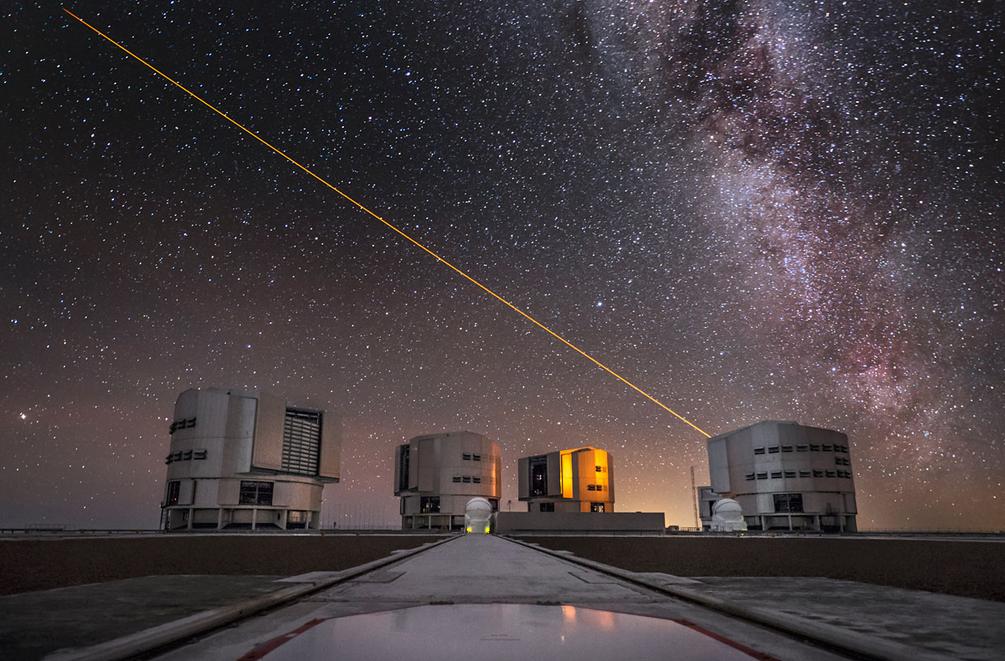
ESO is preparing to define a roadmap for the next generation of instruments for the Very Large Telescope – VLT through the VLT Beyond 2030 call. In this context, European institutes are organising themselves to consolidate existing instrumentation ideas or to propose innovative new concepts. INAF, with its well-established technological expertise, spanning optomechanics, adaptive optics, cryogenics, and detector development, and its broad scientific community, stands as a key stakeholder in this landscape. 
This workshop aims to build a comprehensive, shared picture of INAF's positioning: identifying the instrument proposals in which the institute is already involved, emphasize the scientific goals, the synergies with existing or future facilities/instrumentation, clarifying both technological and scientific held in the various proposals, uncovering possible synergies across the different units, and structuring a coordinated strategy to maximise INAF's impact and visibility in the selection process for the future VLT instrumentation.

We encourage all INAF researchers and technologists to attend the meeting and contribute to building a shared and comprehensive picture of INAF's positioning in the VLT Beyond 2030 landscape. 
Contributions/abstracts may cover:

  • science cases
  • technological contributions (optomechanics, adaptive optics, cryogenics, detectors, SE, software,...)
  • involvement in existing proposals


Your ideas, expertise and vision are essential to consolidate our community's strategy and maximise INAF's impact.


Follow the link for more information about the VLT Beyond 2030 call at ESO.


Note per la registrazione

Per sottomettere un abstract, è necessario un account INDICO o IDEM. Se ne fossi sprovvisto, richiedilo su https://indico.ict.inaf.it/login/ scrivendo: Per il workshop ESO VLT Beyond 2030. Ti sarà attivato rapidamente.

  • Thursday 8 October
    • 13:00 → 14:00
      Registration
    • 14:00 → 14:10
      Welcome
    • 14:10 → 16:10
      Session 1
      • 14:10
        ESO VLT: status and call 40m
        Speaker: Cêline Peroux
      • 14:50
        INAF involvement in VLT 20m
        Speaker: Marcella Marconi
      • 15:10
        MAVIS - The MCAO Next Generation Facility Instrument for the VLT 20m
        Speaker: Giovanni Cresci
      • 15:30
        SAXO+: Enhancing SPHERE high-contrast capabilities 20m
        Speaker: Emiliano Diolaiti
    • 16:10 → 16:40
      Coffee break 30m
    • 16:40 → 18:00
      Session 2
      • 16:40
        MICHELANGELO: an L/M high resolution spectrograph for exoplanetary science 15m
        Speaker: Leonardo Testi
      • 16:55
        The science case of MICHELANGELO: a deep, high-resolution view of the L-band and M-band sky 15m
        Speaker: Lorenzo Pino
      • 17:10
        Resolving protostellar outflow rotation: from ERIS to MAVIS and beyond 20m
        Speaker: Antonio Armeni
      • 17:30
        Observational cosmology with Surface Brightness Fluctuations from Euclid to AO-assisted data 10m
        Speaker: Michele Cantiello
      • 17:40
        TILING I: Field-level Bayesian reconstruction of cosmological initial conditions during the epoch of reionization 10m
        Speaker: Nikolaos Triantafyllou
      • 17:50
        Low-Surface Brightness research in the Next Era of Astronomy 10m
        Speaker: Marilena Spavone
    • 18:00 → 19:00
      Discussion / Round Table: What Cutting-Edge VLT Science Made in INAF?

      What Cutting-Edge VLT Science Made in INAF?

      Consiglio Scientifico

      • 18:00
        Round Table: What Cutting-Edge VLT Science Made in INAF? 1h
        Speaker: Consiglio Scientifico
    • 19:00 → 21:00
      Welcome cocktail 2h
  • Friday 9 October
    • 09:00 → 11:00
      Session 3
      • 09:00
        Synergies with other facilities (SKA,CTA) 30m
        Speaker: Filippo Maria Zerbi (Istituto Nazionale di Astrofisica (INAF))
      • 09:30
        Synergies with space facilities 30m
        Speaker: Adriano Fontana (Istituto Nazionale di Astrofisica (INAF))
      • 10:00
        HRMOS: a high-resolution, multi-object spectrograph for the VLT 20m
        Speaker: Maria Sofia Randich (Istituto Nazionale di Astrofisica (INAF))
      • 10:20
        The need for a wide-field IFU at 1 micron on the VLT 20m
        Speaker: Nicolas Bouche (CRAL)
      • 10:40
        From VIMOS to 2030 and Beyond: The COSMOS Group’s Expertise in Spectroscopic Software 20m
        Speaker: Adriana Gargiulo (Istituto Nazionale di Astrofisica (INAF))
    • 11:00 → 11:05
      Group Photo
    • 11:05 → 11:25
      Coffee break
    • 11:25 → 13:05
      Session 4
      • 11:25
        Gravity+ 20m
        Speaker: Antoine Mérand
      • 11:45
        ESPRESSOred: Towards a full visible and near infrared high-resolution and high-fidelity spectroscopic facility 20m
        Speaker: Xavier Dumusque
      • 12:05
        SHARPS: concept for a short-wavelength, 3rd-generation VLTI instrument 20m
        Speaker: Stefan Kraus
      • 12:25
        A multi-band, fast imager and spectrograph optimised for transients 20m
        Speaker: Antonio de Ugarte Postigo (LAM-CNRS)
      • 12:45
        CUBES (Cassegrain U-Band Efficient Spectrograph) - Bringing a unique capability to ESO's VLT 20m
        Speaker: Stefano Covino
    • 13:05 → 14:00
      Lunch
    • 14:00 → 15:30
      Panel Discussion: INAF's Role and Commitment Now and in the ELT Era

      INAF's Role and Commitment Now and in the ELT Era

      Presidente, DS, UTG-A, UTG-B, Adriano Fontana, Filippo Maria Zerbi