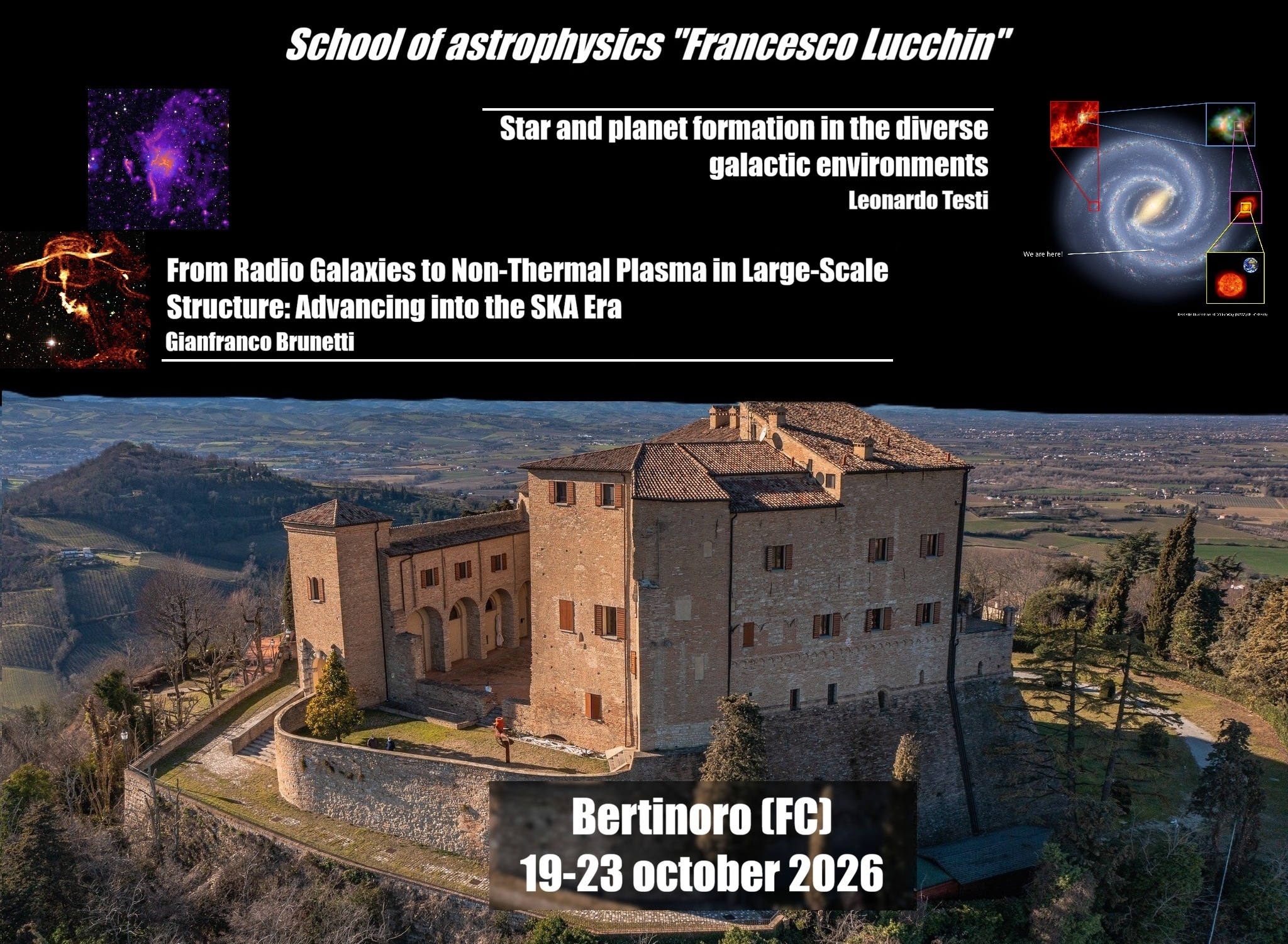
From radio galaxies to non-thermal plasma in large-scale structure: advancing into the SKA era
Radio galaxies, the propagation of relativistic jets, and their evolution within the surrounding environment constitute a fundamental cornerstone of modern astrophysics. On much larger scales, galaxy clusters and
Large-Scale Structures (LSS) host prominent diffuse non-thermal phenomena, embedding cosmic webs with magnetic fields and relativistic particles.
These two domains are profoundly interconnected, as the continuous energy injection from radio galaxies acts as a primary catalyst, seeding and driving the non-thermal emission observed across the intergalactic space.
In recent years, the deployment of Square Kilometre Array (SKA) precursors and pathfinders, such as LOFAR and MeerKAT, has sparked an observational revolution. By revealing an unprecedented, highly complex phenomenology at low radio frequencies, these facilities have raised fundamental questions regarding the exact physical mechanisms governing these systems.
This PhD school aims to investigate these interconnected topics through a modern, comprehensive framework, systematically projecting current constraints toward the upcoming breakthroughs of the SKA observatory.
The program will specifically address the following items :
- The physics of relativistic jets and their propagation within the magnetized intracluster medium (ICM).
- The evolution of radio galaxies, emphasizing their energetic interaction and feedback mechanisms with the host environment.
- The origin and nature of diffuse, cluster-scale non-thermal phenomena, such as radio halos, relics, and synchrotron bridges connecting large-scale cosmic webs.
- The origin and properties of magnetic fields in galaxy clusters and the LSS.
- The microphysics of particle acceleration (via shocks and turbulence) and their subsequent transport and propagation within extragalactic astrophysical plasmas.
Star and planet formation in the diverse galactic enviroments
Galaxies are the visible structures of the Universe, the places where baryonic matter is continuously transformed from the diffuse medium into stars, then re-injected into the diffuse medium again, as part of the lifecycles of stars. Not completely irrelevant to us, at each iteration of this lifecycle, a small fraction of these Baryons gets locked in planets, their atmosphere and biospheres. One of the great efforts of modern astrophysics has been and is being to transform our understanding of Star and Planet Formation in the Galaxy from a *descriptive* to a *predictive* theory. This course will focus on providing the students with our current understanding of the Milky Way as a star (and planet) forming engine. The topics will cover our current understanding of the physical processes at work from the scale of the disk of the Galaxy down to the scale of planet forming disks, including the feedback loops from the small to the large scales, and their observational constraints. While it is still beyond our reach to quantitatively predict star and planetary systems architectures as a function of space and time in the Galaxy, the lectures will present the current successes and the active areas of research towards this goal, which now appears to becoming closer to our reach.
The program addresses:
- Star formation in the Milky Way from the large scale galactic environments to star forming cores
- From cores to disks, and the evolution of solids and volatiles
- Observational properties of disk populations in galactic environments
- Theoretical evolution of protoplanetary disks and planet formation
- Observational constraints on planets and disk-planet interaction
The school covers all meals and transfers from and to Bologna by bus, but the hotel is not covered. For more details check on the logistics and accomodations page.
SOC
L. Testi (UniBO-DIFA), G. Brunetti (INAF-IRA), V. Roccatagliata (UniBO-DIFA), M. Brienza (INAF-IRA)
LOC
A. Tabellini (INAF-IRA), D. Govoni (INAF-IRA), V. Roccatagliata (UniBO-DIFA), M. Brienza (INAF-IRA), R. Partisani (Ceub)