Description
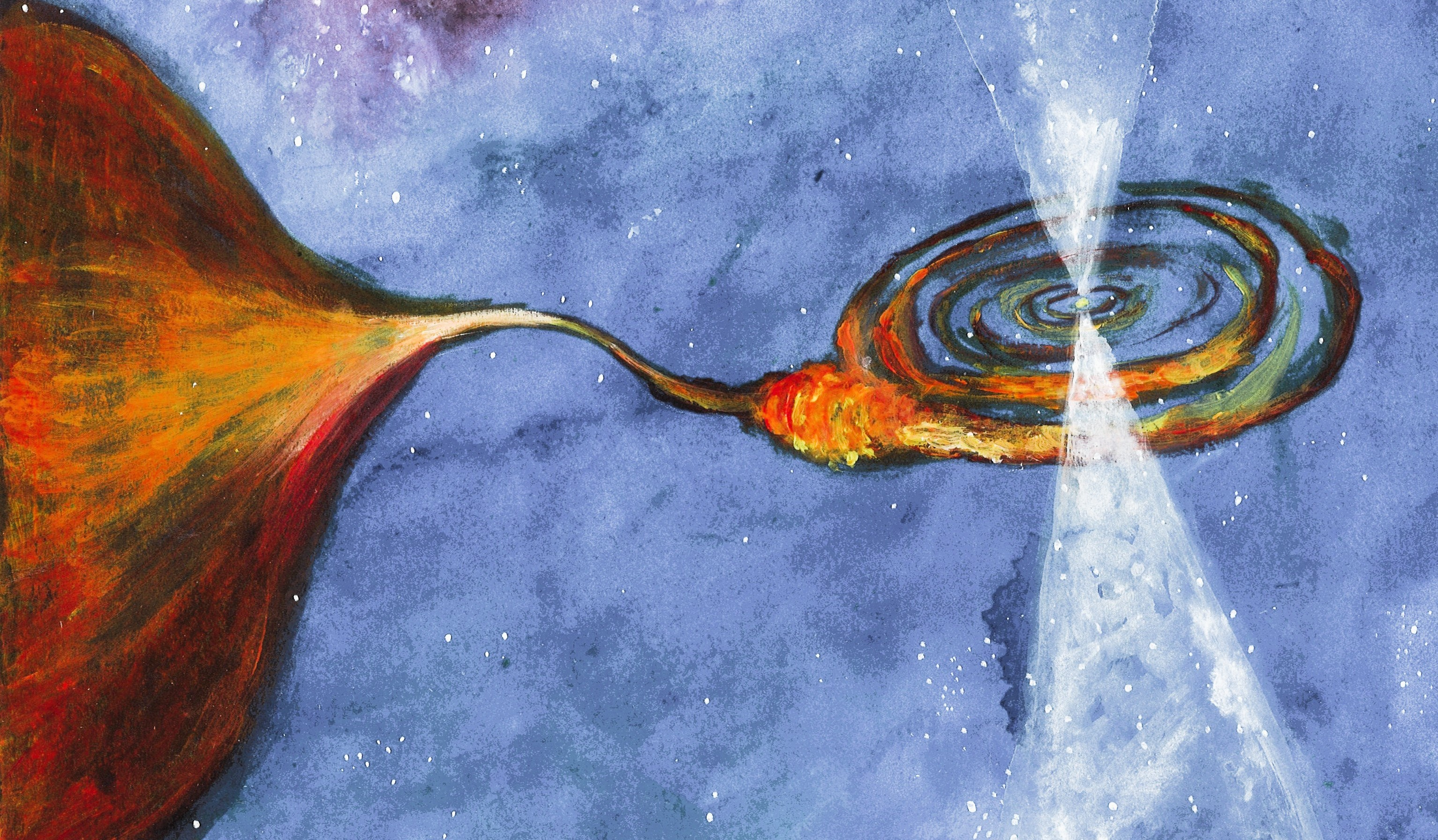
Black Hole Transients (BHTs) are binary systems composed of a stellar-mass BH and a companion
star typically less massive than the Sun. These sources emit over a wide range of electromagnetic
frequencies, from radio to gamma-rays. Their multi-band spectral energy distribution is dominated
by two main components: an accretion disk, emitting from the optical to the X-rays, and a jet,
emitting from radio to NIR. Despite being apparently opposite phenomena, matter inflows (in the
disk) and matter outflows (in the jet) are profoundly intertwined, to the extent that we can call
them two faces of the same medal. Unfortunately, the details of such a coupling are far to be fully
understood, including the physical engine that launches jets and the role that the mass and/or
spin of the BH (if any) plays in this scenario. In this context, multi-band observations, especially
in the optical-NIR band, as it lies at the interface between jet and disk emission, are fundamental
to solve these questions. Fast optical photometry has in particular emerged as a powerful tool
to disentangle these components in the time domain, providing unique insights into the causal
connection between inflow and outflow. IIn this talk, I will review our current understanding of
the disk–jet connection in black hole transients and highlight how fast optical photometry has
advanced, and will continue to advance, the field, providing access to physical source scales, jet
speeds, the origin of quasi-periodic oscillations, and the coupling between accretion and ejection.