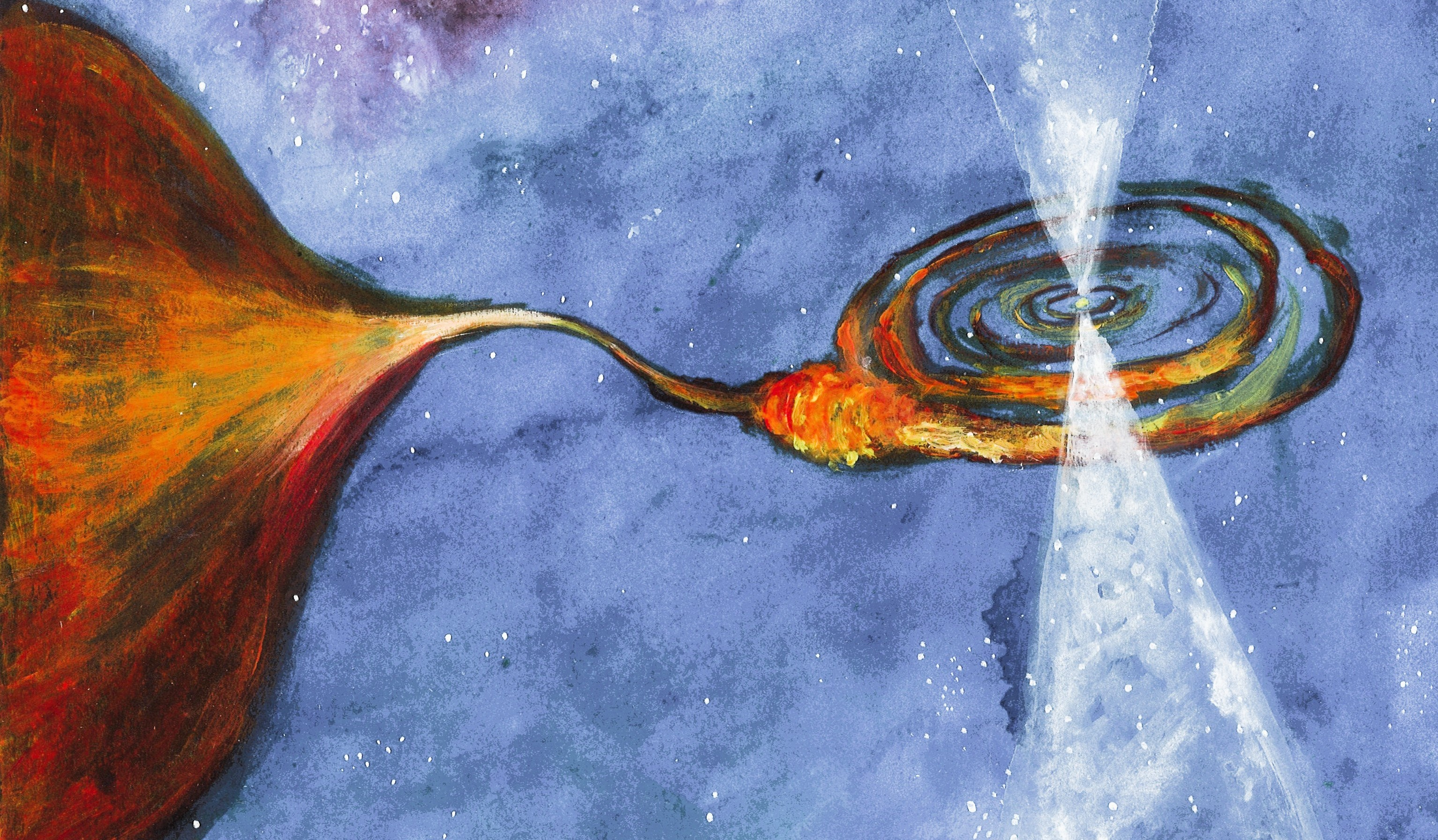
Description
The discovery of millisecond optical pulsations in SAX J1808.4−3658 and PSR J1023+0038 has
opened a new window on the interplay between accretion, magnetic fields, and particle acceleration
in neutron-star binaries. In this talk I will review the main physical ideas that have been
proposed to explain these signals, from accretion-powered hotspot scenarios to synchrotron models
associated with compact magnetospheric interaction regions or striped/pulsar-wind-like dissipation.
I will then compare the observational constraints provided by the two prototype systems
and discuss how they may point to different radiative regimes: a more clearly two-component
picture in SAX J1808, with X-ray pulsations linked to polar accretion and optical/UV pulsations to
a non-thermal synchrotron component, versus a more nearly optically thin and spectrally unified
pulsed component in PSR J1023. The goal is to identify which elements of the phenomenology
may be source-specific and which may reflect a common underlying engine.