Choose timezone
Your profile timezone:
The Ariel space mission, adopted by ESA, represents a cornerstone of European exoplanet science and a strategic opportunity for Italy to consolidate a leading role in the study of exoplanetary atmospheres. Ariel will perform a homogeneous spectroscopic survey of approximately 1000 transiting exoplanets, enabling a population-level understanding of planetary atmospheres, formation pathways, and evolutionary processes. The mission is scheduled for launch in 2031, with payload development and community preparations in a critical phase over the next years.
Since 2019, the Italian community actively engaged in Ariel has organised a series of national meetings dedicated to consolidating scientific activities, defining preparatory analyses, and consolidating national contributions to the Ariel Mission Consortium. The 5th national meeting for the preparation of the Ariel space mission (May 2026) is a strategic continuation of this effort successfully to bring together researchers working on stellar and planetary characterisation, atmospheric simulations, spectral synthesis, host star properties, and mission dry runs, fostering collaboration and establishing concrete preparatory steps for high-impact science in the Ariel era.
The meeting aims to:
NEWS: A link for online attendance will be available to the participant list.
LOC: M. Tsantaki (chair), L. Magrini (co-chair), Andrea Lorenzani, Tomas De Azevedo Silva, Jose Luis Schiappacasse Ulloa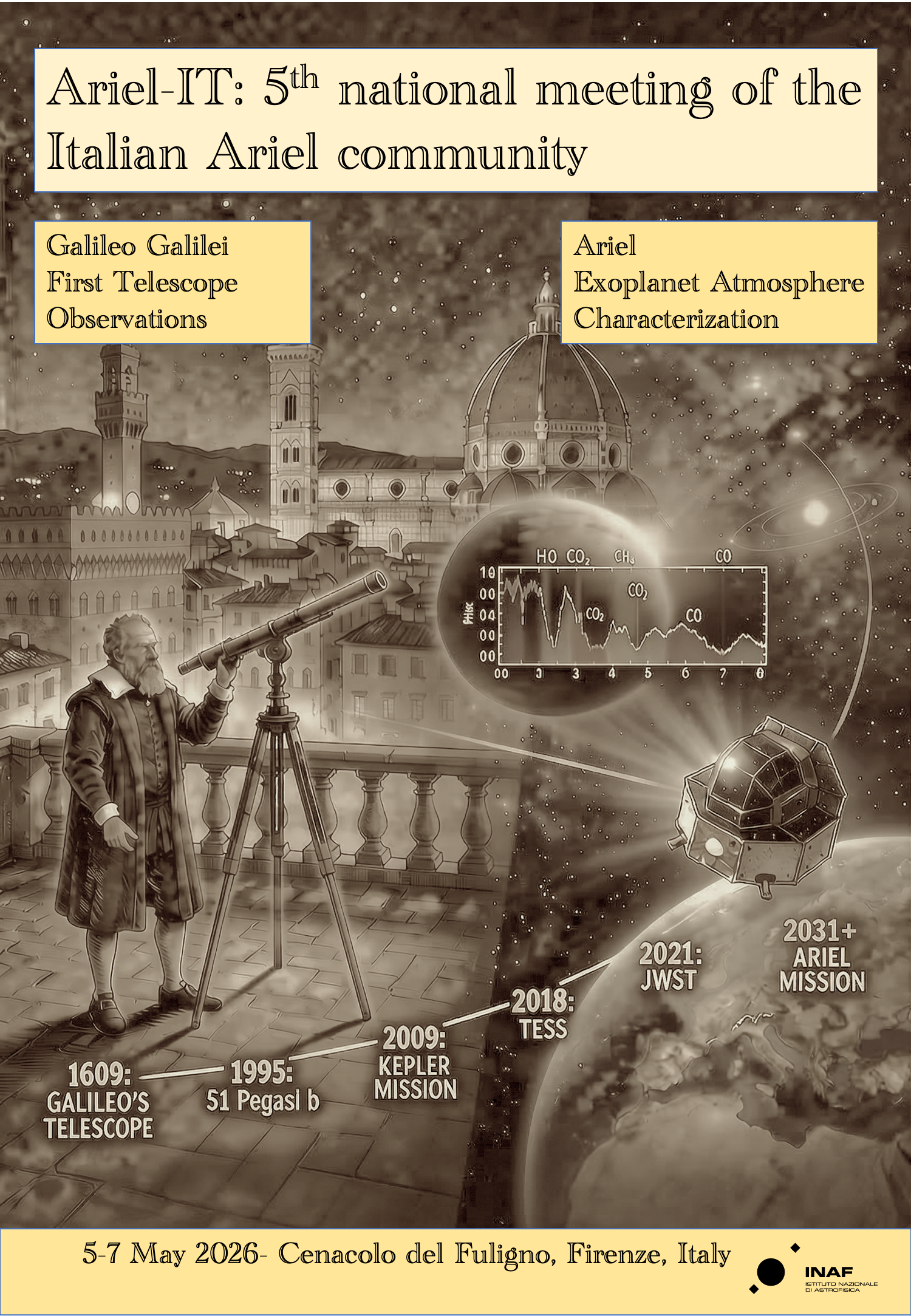
The ARIEL scientific payload has entered a key implementation phase in which subsystem development, integration readiness, and performance consolidation are central to mission progress. This presentation will provide an overview of the current status of the payload, with emphasis on the main subsystem architectures, development milestones, and ongoing activities toward qualification and integration.
Particular focus will be given to the Italian contribution to the payload, which includes the telescope assembly, the Instrument Control Unit (ICU), the Front-End Electronics of the Fine Guidance/photometric channel (FCU), the on-board software, and the thermal architecture. Their functional roles, interfaces, design drivers, and current implementation status will be discussed in the context of overall payload performance and system-level requirements.
The presentation will highlight how the coordinated development of these elements contributes to the scientific readiness of the mission and to the delivery of a stable and high-performance observatory for exoplanet atmospheric spectroscopy.
To obtain precise and accurate information on the Ariel exoplanet host stars a wide variety of good quality data is needed. In particular, high SNR, high-resolution optical and near-infrared spectra are fundamental to derive homogeneous stellar parameters and abundances, that are crucial both to characterise the star and to better understand the exoplanetary information that will be obtained by Ariel.
In this talk, I will describe the activities of the Observations sub-Working Group of the Stellar Characterisation WG, from archival mining to new observation planning, the results achieved so far, and the future works foreseen.
Homogeneous and precise measurements of elemental abundances in planet-hosting Ariel targets are essential for accurately characterizing planetary properties and for providing key constraints on planet formation and evolution processes. In this talk, I will present results from the Elemental Abundance sub-working group of the Ariel Stellar Characterization Working Group, focusing on homogeneous and precise determinations of volatile and refractory element abundances (Na, Mg, Al, Si, S, Ti, Ni, Y) derived from high-resolution spectroscopy. I will discuss the relationships between elemental abundance ratios and explore their possible connections with planetary properties, paying attention to planet-hosting stars belonging to the Galactic thin and thick disks, and considering potential differences linked to their distinct formation histories.
The derivation of elemental abundances for the stars belonging to the Ariel mission candidate sample is an ongoing task under the responsibility of the Stellar Characterisation Working Group. In da Silva et al. (2024), we published the first results regarding the abundances of carbon, nitrogen, and oxygen for a subsample of 181 FGK dwarf stars with stellar parameters (effective temperature, surface gravity, microturbulent velocity, and metallicity) derived by Magrini et al. (2022). More recently, the stellar parameters have been revised, and a subsample of fast rotators (Tsantaki et al. 2025) and hot stars (Ramler et al. 2026) have been included. Here we show the preliminary results in which the CNO abundances are revised using updated stellar parameters, where available, together with more recent atomic and molecular data. Moreover, additional high-resolution spectra, either from public archives or from recently acquired observations, are being continuously included in our study. By enlarging the sample for which we perform an homogeneous determination of the stellar parameters and abundances, based on the newest available data, we aim at improving the already known key relations between planetary and stellar parameters and, in addition, exploring possible hidden connections involving planetary systems.
X-ray and UV irradiation from stellar hosts is an important ingredient for modeling photochemistry and photoevaporation processes in exoplanetary atmospheres.
In the framework of the Italian Ariel Dry-Run esperiment, we have characterized the high-energy emission of the stellar hosts in 8 selected exoplanetary systems.
We will present the results of this study, including predictions of the X-ray flux based on classical proxies of stellar magnetic activity, and predictions of X-ray and EUV irradiation based on synthetic XUV spectra.
For a few cases, we were able also to perform comparison with actual measurements based on XMM-Newton and HST high-resolution X-ray and FUV spectra.
High-energy stellar radiation (extreme ultraviolet and X-rays, collectively XUV) plays a pivotal role in Star-Planet Interactions (SPI), profoundly shaping the chemical composition and evolution of exoplanetary atmospheres. In this work, we assess the capability of the Ariel space mission to detect spectral signatures resulting from XUV radiation. To this end, we employ cpzephyr, a newly developed 1D chemical kinetics and photochemistry code designed to robustly simulate highly irradiated environments. cp_zephyr explicitly accounts for vertical mixing and photochemistry, incorporating a highly detailed treatment of ionization processes. By investigating a sample of eight gas giants and sub-Neptunes, we find that while XUV radiation impacts the atmospheric chemistry in all cases, these effects translate into detectable spectral signatures only for planets orbiting the most active stars.
The evolutionary history of exoplanetary atmospheres is inextricably linked to the activity of their host stars. High-energy stellar irradiation (XUV) and magnetic forces drive complex Star-Planet Interactions (SPI), profoundly altering atmospheric chemistry and driving atmospheric escape. In this talk, we explore these dynamic interactions. We will discuss how the combined effects of stellar activity and cloud coverage impact transmission spectra, highlighting the critical implications for atmospheric characterization with next-generation space missions like Ariel.
The objective of this work is to investigate stellar flaring activity in the confirmed
exoplanet host stars of the Ariel Mission Candidate Sample (MCS, July 2024 release), with
the aim of assessing flare probabilities during transit spectroscopy. From the 657 stars
included in the catalogue, we select a subsample of 290 nearby systems (d < 200 pc) with
available TESS light curves, representative of the current Ariel target distribution. Light
curves are analysed using an iterative Gaussian Process detrending and flare
characterization technique described in Galletta et al. (2025), providing flare amplitudes,
durations, and energies. For this population, we compute the cumulative flare energy
distribution and derive power-law slopes, finding a mean value of −1.87 with a standard
deviation of 1.55. Using these flare statistics, we estimate the probability of detecting a
flare above a given energy threshold during a planetary transit. We find that for the most
active stars in the Ariel sample , AU Mic, HD 28109, and WASP-14, the probability of a
flare overlapping a transit can approach ~50%, potentially affecting atmospheric
retrievals, noise budgets, and visit planning. Our results highlight the importance of
incorporating flare statistics into Ariel mission strategy, both for optimizing scheduling
and for developing dedicated correction methods for flare-contaminated spectra.
In the era of large-scale photometric surveys that achieve millimagnitude-level relative precision and have discovered thousands of exoplanets and binary systems, reassessing and improving the absolute flux scale has become essential. Accurate absolute magnitudes are critical for the detailed characterization, classification, and understanding of the formation and dynamical evolution of planetary and binary systems.
We computed synthetic TESS magnitudes for a set of high-quality spectro-photometric standard stars from the SPSS and CALSPEC libraries. The calculations were performed using both the original high-resolution library spectra and the low-resolution Gaia BP/RP mean spectra. The resulting synthetic TESS magnitudes achieve an internal precision of 0.0075 mag. A revised TESS zero point for synthetic photometry is derived, and TESS magnitudes are provided for stars in the ARIEL input catalogue.
We conclude that TESS magnitudes can be reliably determined through direct integration of Gaia BP/RP spectra — despite their incomplete wavelength coverage — reaching a significantly higher precision and improved accuracy compared to the ∼0.15 mag typical uncertainty of the TIC broad-band estimates.
Connecting planetary atmospheric compositions to their formation environment has become a central challenge in exoplanet science. This link is shaped by the coupled chemical and dynamical evolution of protoplanetary discs, which determine the chemical makeup of the gas and solids accreted by growing planets. I present a new time-dependent framework that combines the long-term physical and chemical evolution of discs with models of giant-planet growth and migration. The disc model includes viscous gas transport, turbulent mixing, radial dust drift, and volatile chemistry across a range of chemical scenarios. We find that even sub-micron grains can drive significant chemical evolution in chemically reprocessed discs, and that the drift and sublimation of ~100 µm icy grains can strongly enrich regions inside snowlines, enhancing key volatiles by up to an order of magnitude. Early planetesimal formation and refractory carbon erosion further imprint distinctive elemental signatures on the disc gas. Coupling these evolving discs to models of giant-planet accretion reveals multi-element trends that link the composition of planetary envelopes to both formation pathways and natal disc chemistry. These trends establish a new metric for interpreting atmospheric measurements and are directly applicable to current and forthcoming surveys - including Ariel’s - offering a route to constraining the natal chemical environments and evolutionary histories of giant planets.
Pebble accretion process is known to be very sensitive to the initial conditions of the protoplanetary disc and a growing body of work is exploring its dependence on fundamental disc parameters (viscosity, mass, dust-to-gas). Notwithstanding this, the impact of the elemental set up of the disc, traced by the stellar composition, on the planetary occurrence rates and mass spectrum remains largely unexplored. In this talk we will present recent advancements obtained in the framework of the Ariel space mission and the GAPS and HRMOS projects on such aspects of the star-disc-planet connection.
Planet population synthesis models can only partially reproduce the observed population of planets in full. Such models implement different prescriptions for planet formation and disc evolution. We explore the impact of different disc models on the planet population they produce. We adopt two families of discs: the viscosity-driven and the MHD winds-driven model, in turn divided into steady and non-steady evolutionary models. Planets grow through pebble plus gas accretion, and migrate due to planet-disc interactions. We aim to constrain different formation environments from the planet populations they form. The evolution of the dust-to-gas ratio of the disc strongly impacts the variety of the population of planets and creates preferred regions for planet formation. In particular, the latter give rise to two populations of giants, with similar core masses, but different formation histories and potentially different composition. The efficiency of MHD winds changes the relative occurrence of these two populations. Regardless of the disc family, MHD winds extend the mass spectrum of gas giants produced by non-steady models, and reduce the migration distance of planets in both steady and non-steady models. Based on the above results, we identified diagnostics for the planet-forming environment based on the distribution of final orbits and masses of the planets. Our results suggest that one single disc model can hardly reproduce the entire observed population of planets. Rather, multiple models should be taken into account.
Current space observatories already allow for the spectral characterisation of exoplanetary atmospheres with a level of detail that exceeds what current retrieval and interpretation frameworks can reliably disentangle. The “Origins of Planets for ArieL” project addressed this challenge in preparation to the Ariel mission by creating, ab initio, an extensive physically-realistic library of synthetic exoplanet compositions on which to test, under controlled conditions, the readiness of the Ariel tools and pipelines. To achieve OPAL’s goals, we developed new methodologies, HPC codes and multi-physics simulation pipelines that provide the national community with state-of-the-art tools and the only end-to-end planet formation modeling suite at international level. In this talk I will introduce the OPAL project, the Arχes suite of planet formation that made this effort possible, and how the know-how derived from this project can benefit the Ariel-IT and the national community at large.
In this talk, I will present a summary of the observational efforts to characterise the planets that could be observed by Ariel and how these studies can support the selection of the future Ariel targets.
In particular, I will present the "Ariel Masses Survey (ArMS)" with the HARPS-N spectrograph at the Telescopio Nazionale Galileo, which is a five-year large program dedicated to the radial velocity monitoring of stars hosting transiting planets with radii spanning the so-called "Radius Valley" (1.3 – 2.5 $R_{\text{Earth}}$). These types of objects belong to the transition region between super-Earths and sub-Neptunes and may show very different internal and atmospheric composition. Up to now, the mechanisms behind their observed diversity are still not understood, partly because a robust knowledge of their planetary mass is not easy to obtain, due to the presence of additional companions or stellar activity signals. A reliable mass determination is also crucial in the context of Ariel, to obtain a robust retrieval of the chemical species and atmospheric properties of these planets. Placed within the activities of the Ariel Consortium Mass Determination WG and as part of the Italian GAPS Collaboration, ArMS is starting to deliver the first mass measurements of sub-Neptune planets hosted by single or multi-planet systems. Our program also includes simulations of the atmospheres of the analyzed planets, and thus provides useful information regarding the selection of the most suitable targets for future observations with Ariel.
One of the key goals in planetary population studies is to achieve broad coverage of the parameter space, which is not fully covered by the currently confirmed planets. We can fulfil this aim by incorporating validated planets even if they have not been confirmed yet. Therefore, we can validate them through a vetting procedure. Within the Ariel Mission Candidates Sample, the TESS Planet Candidates (TPCs) catalogue includes planet candidates that have not yet been validated. In preparation for the Ariel launch, we selected a subsample of these targets and analysed them through a vetting procedure. We based our methodology on the TRICERATOPS tool to confirm the presence of transiting planets or rule out the candidates. The vetting process consists of a detailed analysis of photometric data to examine periodic, transit-like signals originating from target stars. Its purpose is to classify these signals as either planet candidates or false positives. This process allows for the statistical rejection of astrophysical false-positive scenarios with a high level of confidence. In addition, it is possible to incorporate constraints obtained thanks to follow-up observations, such as high-resolution imaging or ground-based photometry. From the TPCs, we selected all the candidates hosted by stars cooler than 5000 K, yielding a sample of nearly 318 targets. Among these, we validated 68 planets. These results contribute to refining the TPCs by promoting validated candidates to planets and ruling out spurious detections.
We present a new, self-consistent catalog of planetary parameters derived from the ARIEL Stellar Catalogue (ASC), a homogeneous dataset of stellar properties. Our work leverages this robust reference frame to provide accurate planetary characteristics for systems in the ARIEL Mission Candidate Sample. We compare our newly derived planetary parameters with those available in the literature,
revealing and addressing significant discrepancies often caused by heterogeneous stellar data. This effort ensures that both stellar and planetary properties are consistent, enabling more reliable population-level studies. Using this new catalogue, we conduct a demographic investigation of the exoplanet population within the sample. We explore correlations between various planetary parameters, such as mass, radius, and orbital properties, shedding light on potential trends that can inform our understanding of planetary formation and evolution. By providing a unified and accurate dataset, our work prepares the ground for the success of the ARIEL mission and pushes the state-of-the-art in exoplanet science forward.
Precise planetary mass measurements are essential for constraining the internal structure and atmospheric properties of exoplanets. In the framework of the ESA Ariel mission, accurate masses are required to break key degeneracies in atmospheric retrievals. Estimating the observational effort needed to reach the desired mass precision is therefore crucial for the optimisation of current and future radial velocity (RV) surveys. To address this, we developed MINERVA, a tool designed to estimate the minimum number of RV observations required to measure the mass of transiting planets with a given precision. The code simulates RV time series for targets orbiting FGKM-type stars, accounting for instrumental noise, stellar activity, and realistic temporal sampling. It builds upon a synthetic stellar population representative of the solar neighborhood, assigning age, rotation, and magnetic activity through empirical calibrations, and converts the resulting activity levels into RV jitter amplitudes. As part of the code development, we derived a new empirical calibration between chromospheric activity and RV dispersion specifically for K-type stars, based on data from the GAPS and ArMS programs. We successfully validated MINERVA on individual targets with known planetary masses, yielding predictions for the required observational effort that are highly consistent with the values reported in the literature. Finally, to demonstrate its capability on statistically significant samples, we applied the code to a subsample extracted from the Ariel Mission Candidate Sample. Adopting HARPS-N@TNG as the reference instrument, we estimated the total number of observing nights required to achieve a planetary mass precision of 30%, providing a highly optimized observational roadmap for robust atmospheric retrievals.
Since the first detection of an exoplanet in 1995, the field has undergone a huge transformation, shifting the focus from planetary detection to detailed atmospheric characterisation. Ground- and space-based observatories have revealed a stunning diversity in planetary masses, radii, and orbital architectures, and exoplanetary atmospheres now hold the key to understanding the origin of this diversity through their observable spectral signatures. As the field transitions from an era of molecular "species discovery" to one of "atmospheric characterization," the synergy between space-based Low-Resolution Spectroscopy (LRS) and ground-based High-Resolution Spectroscopy (HRS) has emerged as a crucial multi-technique approach. LRS, provided by facilities like HST and JWST, offers broad wavelength coverage and sensitivity to continuum levels, enabling the detection of molecular bands. However, it remains limited in its ability to resolve individual line profiles or disentangle overlapping species. In contrast, HRS instruments (such as HARPS-N, GIANO-B, CRIRES+, ESPRESSO, and MAROON-X) resolve line shapes. This enables cross-correlation mapping of atmospheric species and probes layers above high-altitude clouds and hazes, which often mute spectral features in LRS data. By integrating these complementary datasets within joint retrieval frameworks, we can simultaneously break degeneracies between temperature structure, cloud deck pressure, and chemical abundances, constraints that are often unachievable by either technique in isolation. In this contribution, we present ongoing efforts to combine HRS and LRS observations, demonstrating how joint retrieval algorithms yield significantly tighter constraints on atmospheric composition and thermal structure compared to separate analyses. Looking ahead, the combination of the Extremely Large Telescope (ELT), ARIEL, and JWST represents the next frontier of this synergistic approach.
Oxygen is a reactive element that bonds not only to C and H, but also to a variety of other relatively abundant elements like Si, Mg and Fe. How much of this element we miss when we fail to account for species other than H2O and CO has yet to be fully determined within the framework of disequilibrium chemistry. The fate of oxygen is determined by the delicate balance between competing chemical, dynamical and condensation timescales. Wherever this sequestration is efficient, the impact on the retrieved C/O ratio can be substantial, since up to 30% of the O stock in a Solar-composition atmosphere can be locked away in undetected species. In this contribution we utilize a new chemical kinetics network to study how oxygen partitions among its main volatile and refractory carriers (including key Si, Mg and Fe oxides and hydroxides), for a grid of planets with different equilibrium temperatures, metallicities and vertical mixing strengths, while testing different hypotheses concerning the behavior of both iron and rock-forming condensates.
We present a systematic review of the reported detections and non-detections of chemical species, both atomic and molecular, in the atmospheres of the End to End experiment selected sample of exoplanets, obtained employing ExoAtmospheres database to access the studies on atmospheric characterisation. The analyzed sample covers a broad equilibrium temperature range, spanning from 700 K for V1298 Tau b to 1673 K for HAT-P-14b. The results highlight how the presence or absence of dominant molecules such as H2O, CO2, CO, and CH4, as well as atomic species like Helium (He) and Sodium (Na), varies significantly with increasing equilibrium temperature.
The ARIEL space mission will characterize the atmospheres of hundreds of exoplanets, pushing beyond the canonical hot Jupiters into cooler regimes where longer chemical timescales amplify the roles of transport and photochemistry. In these atmospheres, disequilibrium processes are expected to leave measurable imprints on molecules central to ARIEL's science case, such as H2O, CO2, and CH4, while enhancing the abundances of secondary absorbers such as NH3, HCN, and C2H2.
Using the classical HD 209458 b as a benchmark, we quantify how horizontal mixing, vertical transport, and photochemistry jointly shape transmission spectra. We couple 2D photochemical-transport simulations (VULCAN 2D) with forward radiative transfer modelling (petitRADTRANS) to generate synthetic JWST transmission spectra, enabling direct comparison with existing observational data and providing a framework scalable to ARIEL targets.
We investigate how the interplay between dynamical and chemical timescales alters the abundances of key molecules such as CH4, promoting the formation of species such as HCN and C2H2. For instance, C2H2 features strengthen under enhanced photochemistry but weaken with stronger vertical mixing. We also find that the presence of C2H2 is consistent with solar C/O at low metallicity, while enhanced abundances also emerge at higher C/O ratios across a broader range of metallicities. In contrast, species such as CO2 act as robust metallicity tracers that are largely insensitive to disequilibrium chemistry effects. By directly linking multidimensional disequilibrium chemistry to observable infrared signatures, we show how these processes imprint distinct, and potentially degenerate, features on infrared spectra.
I shall briefly review the PLAnetary Transits and Oscillations of stars (PLATO), an M-class space mission of the European Space Agency that is due to launch in early 2027. It will observe a wide field in the Southern hemisphere for at least two years searching for transiting planets orbiting bright stars and aiming at a precise determination of their radius within 3-5%, of their mass within 5-10%, and of their age within 10% for its stellar primary samples (V mag < 11) by means of asteroseismology. Moreover, data on stellar abundances, rotation, and the level of magnetic activity will be provided that can contribute to the study of planetary atmospheres and the star-planet interactions.
I will discuss the design of the MOS spectrograph that will be proposed to VLT, highlighting its role in the detection of giant exoplanets in different environments.