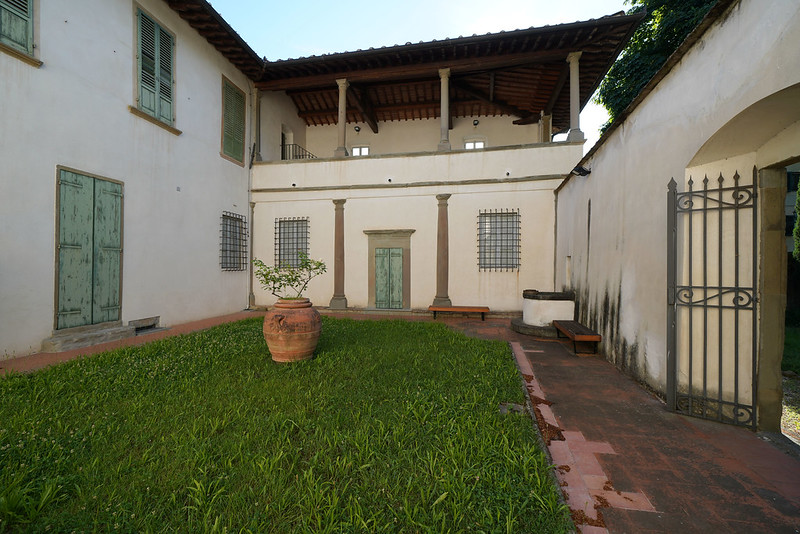
The Villa and its garden still tell of Galileo's scientific studies, his family affections, his relations with the students, and his passion for the vineyards. Galileo rented the Villa in 1631, driven by his daughter Virginia, a nun with the name of Sister Maria Celeste, together with her younger sister, in the monastery of San Matteo, just 300 meters away. The daughters wished that the father, now an elderly man, lived near and, to visit them, should not have to face the two hours of travel on the back of a mule, necessary to reach them from the villa of Bellosguardo where he lived before moving to Villa Il Gioiello. Here, from the window of the room he chose as a studio, Galileo could see the vineyard of his daughters' convent, the Verdea di Arcetri, which produced wine. With him lived the maid Piera who took care of the daily chores following the attentive orders of Virginia, who, despite being a cloistered nun, managed the practical aspects of her father's life from the convent.
It was in the Villa that it originated, for his first print run in 1632, the manuscript of the Dialogo sopra i due massimi sistemi del mondo (Dialogue above the two greatest systems of the world), seized after a few months and subsequently republished in Holland. Within these same walls, Galileo completed his last major work, the Discorsi e dimostrazioni matematiche intorno a due nuove scienze (Discourses and mathematical demonstrations around two new sciences), published in 1638 in Holland when Galileo had already become completely blind. The blindness did not stop him from working and many collaborators alternated at the Villa to help him. Among these, Vincenzo Viviani and Evangelista Torricelli, disciples and interlocutors of learned scientific discussions, lived at "Il Gioiello" with Galileo in the last months of the life of their Master.
Galileo died at the Villa on 8 January 1642 and was buried in a secondary room in the Basilica of Santa Croce with no solemn celebrations.
HOW TO REACH THE VILLA
The Villa can be reached by public transport with bus n. 38 (weekdays), direction Poggio Imperiale. Bus stop: Largo Fermi/Pian dei Giullari.
© Sistema Museale di Ateneo - UniFi