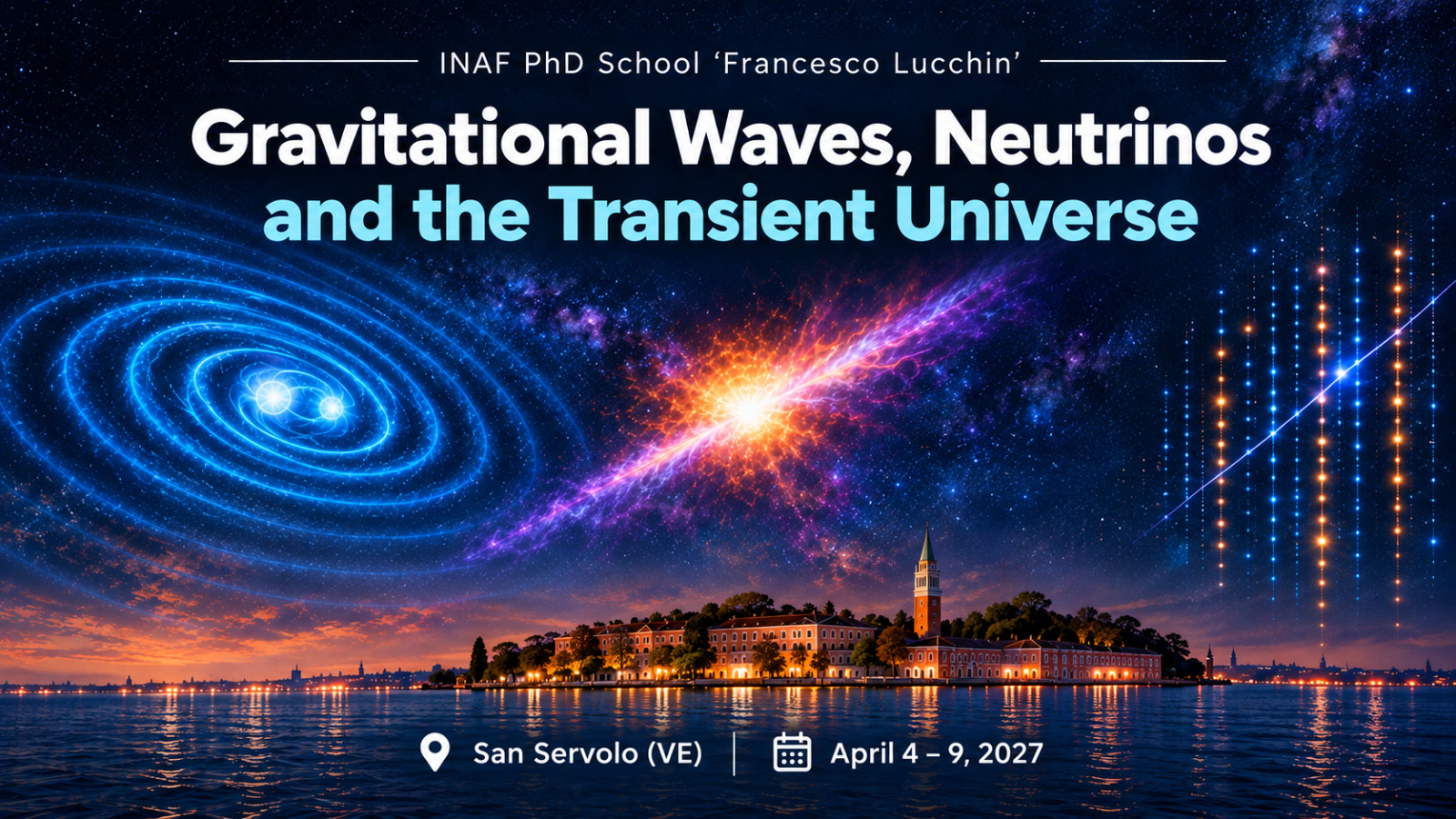
Gravitational Waves, Neutrinos and the Transient Universe
Nearly forty years after SN 1987A—the first astrophysical event observed in both electromagnetic radiation and neutrinos—and ten years after GW170817, which ushered in the era of multi-messenger astronomy with gravitational wave (GW) sources, the study of the transient Universe is entering a new frontier.
Today’s GW astronomy relies on LIGO, Virgo, and KAGRA, while neutrino astronomy is driven by facilities like Super-Kamiokande, IceCube, and KM3NeT. In the coming years, next-generation facilities such as the Einstein Telescope, LISA, and LGWA will revolutionize GW astronomy, complemented by Hyper-Kamiokande and upgrades to existing neutrino detectors. Concurrently, major electromagnetic observatories — including the Vera C. Rubin Observatory, SKAO, and CTAO — will dramatically expand our capacity to discover and follow up on transient sources. This evolving landscape offers early-career researchers a unique opportunity to probe the high-energy, rapidly changing Universe through a multi-messenger, multi-wavelength approach.
The school will take place in San Servolo (VE) in the week from 2027 April 4 to 9.
SOC:
Maria Grazia Bernardini (INAF-OAB, co-chair)
Maria Teresa Botticella (INAF-OACn)
Riccardo Ciolfi (INAF-OAPd)
Paolo D’Avanzo (INAF-OAB, co-chair)
Massimo Della Valle (INAF-OAPd, co-chair)
Luigi Fusco (UniSA)
Marcello Giroletti (INAF-IRA)
Giulia Illuminati (INFN-Bo)
Andrea Melandri (INAF-OAR)
Silvia Piranomonte (INAF-OAR)
LOC:
Nancy Elias Rosa (INAF-OAPd)
Matteo Pais (INAF-OAPd)
Andrea Reguitti (INAF-OAPd)
Irene Salmaso (INAF-OACn)
Chiara Salvaggio (INAF-OAB)
Giorgio Valerin (INAF-OAPd)
For more details, please refer to:
https://indico.ict.inaf.it/e/scuolaLucchinVenezia2027