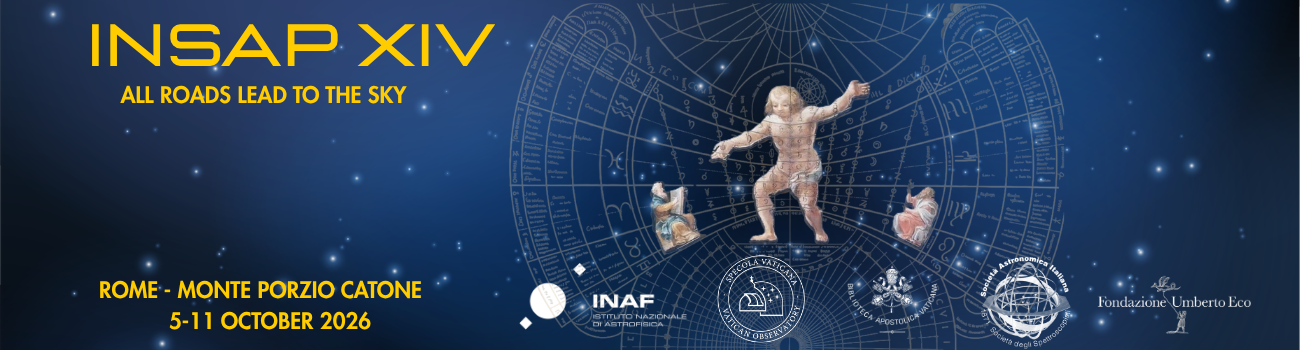
INSAP XIV CONFERENCE ROME-MONTE PORZIO CATONE
"All Roads lead to the Sky" - 5-11 October 2026
We are pleased to present the 14th Inspiration of Astronomical Phenomena (INSAP) conference, a unique event where science, art, and the humanities converge. For millennia, celestial wonders have fuelled human creativity and research; today, Rome—a historic crossroads of culture and tradition—serves as the perfect stage for scholars and artists to explore our enduring connection to the Cosmos and to reaffirm that, indeed, all roads lead to the sky.
To celebrate cosmic influences through the ages, our sessions are hosted in symbolic locations that reveal the deep, intricate web connecting astronomy and culture. These include Villa Mondragone, where Gregory XIII issued the papal bull on the Calendar Reform in 1582 and the main headquarters of the INAF - Rome Astronomical Observatory in Monte Porzio Catone; the Botanical Garden in Rome, where Christine of Sweden's court was located at the end of the 17th century, and where she met Giovan Domenico Cassini to observe the celebrated comet of 1664; and finally the renowned Apostolic Library in Vatican City, where many precious ancient astronomical manuscripts are preserved
Other visits are planned to the INAF-OAR Astronomical and Copernican Museum in Monte Mario and the Vatican Observatory in Castel Gandolfo, where the first INSAP conference was held in 1994. This is a wonderful opportunity to connect with history and beauty while conversing about the Universe and gazing at the stars from the Eternal City.
The Roman edition of INSAP provides an opportunity for scholars and artists from different disciplines and countries to interact and gain new perspectives, forging new collaborations as they immerse themselves in the rich history and heritage of the 'Caput Mundi' — the 'Capital of the World'. Throughout this process, we encourage formal scholarly presentations as well as creative expression, artistic performance and unconventional points of view and formats of communication. At the same time, we will seek to inform and inspire the general public by revealing the hidden treasures at the intersection of human culture and the cosmos.
The conference is organized and part sponsored by the Italian National Institute for Astrophysics (INAF), the INAF-Rome Astronomical Observatory, the INAF-USC-E department Museums Archive Libray area, the Vatican Observatory, the Vatican Apostolic Library and the Italian Astronomical Society.
Keynote Lectures:
- Costanza Barbieri [IT] (Academy of Fine Arts Rome)
- Paolo de Bernardis [IT] (Accademia dei Lincei, Accademia dei XL, Università Sapienza Roma)
- Piero Boitani [IT] (Accademia dei Lincei, Università Sapienza Roma)
- Stanislav George Djorgovski [US] (California Institute of Technology)
- Roberto Trotta [CH] (SISSA Trieste, Imperial College London)